Hold your hats, summer is over (Zeitgeist 19.)
Table of Contents:
1. Rule of Law report is out, and the government does not like it
2. The circle is closing – judicial trainees are back
3. Delays, delays, who will handle them?
4. When a principle of a norm breaks for the benefit of a few
5. This year the parliament did not amend the Constitution… oh, wait, it is only summer yet
6. Ministry of Interior claims to be fooled about Russian cameras
7. The Supreme Administrative Court has a new president
8. Shameful end of the Russian law on transparency of NGOs
9. Usual evergreen of the Judicial Council – general and vague against political attacks on judges
10. New Civil Code in the Parliament
Brussels published its rule-of-law homework, and the government didn’t like the grade: corruption cases going nowhere, fast-track lawmaking, and an ongoing fight over whose law comes first. But the real story is the judiciary quietly bolting its own doors: trainees are back (last seen enabling nepotism before 2011), a hand-picked group of judges gets a VIP lane onto the Supreme Administrative Court, and five-year evaluations are gone.
Add it up and the current bench gets to clone itself. Also on the menu: a Civil Code rewrite of 2,000-plus articles rammed through to-minimum limited parliamentary debate, Russian modules found in road cameras the Interior Ministry swears surprised them, and a constitutional amendment letting voters fire parliament. The lone bright spot, the „Russian law“ on NGOs, finally died for good.
1. Rule of Law report is out, and the government does not like it
The first half of 2026 brought three overlapping assessments of the rule of law in Slovakia, alongside a running constitutional dispute with Brussels. First, the European Parliament adopted a resolution voicing deep concern over amendments to the Criminal Code and Criminal Procedure that, in MEPs‘ view, cut penalties for corruption and economic crime, shortened limitation periods, and abolished specialized anti-corruption bodies, while also questioning the Prosecutor General’s broad powers to halt or slow proceedings and constitutional changes touching the primacy of EU law.
Then, the Civil Liberties Union for Europe reported that all four of its assessed areas, justice, anti-corruption, media freedom, and checks and balances including civic space, had deteriorated in Slovakia during 2025. The European Commission’s annual Rule of Law Report, published on 17 July, recorded no progress on investigating and prosecuting high-level corruption, noting that no major case was uncovered or pursued in 2025 and that Section 363 of the Criminal Procedure Code was left unchanged, and none on public participation in law-making or on the frequent use of fast-track procedures. The Commission saw limited progress on lobbying regulation and on journalists‘ safety, the latter tied to transposition of the anti-SLAPP directive, which it observed shields only cross-border cases, not abusive lawsuits brought by domestic actors.
More substantial movement came in safeguards for removing non-judge members of the Judicial Council, which would still need a constitutional majority to pass. The government also proposed abolishing the offense of „bending the law,“ a step urged by the Council of Europe’s Venice Commission. The government partially rejected the report, strongly disputing the assessment of high-level corruption prosecution, insisting it does not influence criminal proceedings. Throughout the period, the Commission continued an infringement procedure over last year’s constitutional amendment asserting the precedence of Slovak law in „cultural and ethical questions,“ arguing it challenges the primacy, autonomy, and uniform application of EU law. At the same time, the government maintains it protects only competences never transferred to the Union.
2. The circle is closing – judicial trainees are back
In July, the Ministry of Justice put forward a draft law on judicial trainees („justiční čakatelia“), presented as a way to improve the practical preparation of future judges but challenged in public comments for narrowing entry to the bench. Under the proposal, vacancies at district and administrative courts would be filled primarily from among judicial trainees, with open competitive selection for experienced outside lawyers reserved for exceptional cases where no trainee is available. Critics argue this raises a significant barrier for advocates, prosecutors, academics, and other established lawyers, who would have to give up their careers for a three-year traineeship with no assurance of appointment at the end.
They point out that Slovakia abolished the trainee institute before 2011 because it was seen as a channel for nepotism, and replaced it with open competition designed to give senior judicial officers, advocates, and prosecutors an equal chance. The draft would also alter how selection commissions are assembled. Whereas the chair of the Judicial Council currently forms a five-member panel drawn from ministry and Council nominees plus one member chosen by the relevant college of judicial-council court councils chairs, the shift will widen executive influence over appointments. A further objection concerns legitimate expectations, since senior judicial officers who joined the service expecting to sit the judicial exam and apply through mass selection after three years and at age 30 would lose that direct route once mass competitions are scrapped.
Critics also warn of a risk of self-censorship, arguing that trainees dependent on court leadership, the ministry, and the Judicial Council for their futures may lean toward conformity rather than independent legal reasoning. Combined with already-adopted measures, the removal of periodic five-year evaluations of judges and expanded Judicial Council powers in disciplinary matters, the legislative package might let the current judiciary entrench itself and replicate its own composition. This animosity of the Judicial Council toward outsiders entering the judiciary was visible when the Supreme Administrative Court was established, and experts from other legal professions joined the bench. Some Judicial Council members nicknamed them „people from the street.“
3. Delays, delays, who will handle them?
VIA IURIS also objected to a draft amendment to the Act on Courts that would create a mechanism for handling complaints about delays in judicial proceedings and awarding compensation for the resulting harm. We argued that the proposal creates an unsystematic, dual-track regime for such complaints that is confusing for parties and internally contradictory, and that it instead proposes that special panels at the Supreme Court and the Supreme Administrative Court handle the entire caseload, leaving the Constitutional Court only to review their decisions.
It objects to wording allowing a court to „sufficiently ensure the removal“ of delays, warning that the phrase is so vague it could let courts evade responsibility and simulate activity through pointless steps, a risk sharpened by the fact that complainants are not always legally represented. The draft sets out no criteria for when a delay actually arises, and recommends writing in the three tests established by Constitutional Court case law: the legal and factual complexity of the case, the conduct of the party, and the procedure of the court itself. It further argues that courts should be obliged, not merely permitted, to weigh how a case progresses after a complaint is lodged, so that decisions remain predictable and consistent across courts and complainants. On compensation, the organization called for deleting the criterion of „the significance of the proceedings for the complainant,“ which it considers an unavoidably subjective standard without objective benchmarks, adding that every delay breaches the constitutional right to a hearing without undue delay, regardless of what a given dispute is worth.
4. When a principle of a norm breaks for the benefit of a few
Summer 2026 has been rich for draft laws on amendments in the judiciary. Another draft amendment of the Act on Judges, would let judges who belonged to the former administrative-law division of the Supreme Court request a transfer to the Supreme Administrative Court, with the Judicial Council deciding without carrying out the standard review of judicial fitness that Slovak law otherwise requires for moves to a higher court or a change of judicial agenda.
VIA IURIS argued this breaches the principle of equal treatment enshrined in the Constitution, since it creates two categories of candidates for the same post at the same court and waives, for a narrow group, the very vetting, including scrutiny of assets and any links to organized crime, The former was the procedure every judge appointed to the new court went through during its rigorous 2021–2022 selection. The Justice Ministry claimed these judges already have administrative-law experience; however, that claim does not hold up when the existing selection process exists precisely to verify the quality of that experience.
The proposal’s form was also faulty, because it misused transitional provisions. Such provisions are meant to bridge the shift from old rules to new. Yet, this one arrives five years after the Supreme Administrative Court was established and instead carves out a temporary, exceptional exemption within a settled system. The measure violated the principle that laws must be general, since it applies not to an abstractly defined category but to a personally fixed group: judges who sat in the Supreme Court’s administrative division as of 31 July 2021, making it an individual legal act disguised as a statute.
5. This year the parliament did not amend the Constitution… oh, wait, it is only summer yet
The government also brought forward a set of constitutional amendments affecting the Judicial Council and introducing a new mechanism for dismissing parliament. The draft law includes amendments to the Judicial Council; the text reaffirms it as an independent constitutional body guaranteeing the independence and legitimacy of the judiciary, and caps service at two consecutive five-year terms for the chair and for elected or appointed members. It sets out defined grounds for early removal, long-term ill health lasting at least six months, a final conviction for an intentional offense or an unsuspended sentence, or appointment as a judge. Separately, proposed Articles 100a–100c would allow the National Council to be dissolved before the end of its term through a popular vote.
The president would call such a vote on a petition of at least 350,000 eligible voters, announcing it within 30 days so that it is held within 110 days. It could be held only once per electoral term, not during war or a state of war, not in the first or last six months of parliament’s term or the last six months of the president’s term, and not at all if parliament has already voted to shorten its own term. To succeed, recall would require a majority of participants to vote in favor and, as a floor, a three-fifths share measured against the number of voters who took part in the immediately preceding parliamentary election.
6. Ministry of Interior claims to be fooled about Russian cameras
In mid-August, the opposition party Progressive Slovakia called on Prime Minister Robert Fico to dismiss Interior Minister Matúš Šutaj Eštok, citing findings that Russian technology and remote access were built into road cameras the ministry tested. Progressive Slovakia said that an assessment by the National Security Authority (NBÚ), the country’s cyber-security watchdog, identified an undocumented module linked to twelve Russian telephone numbers inside the devices.
Having obtained the assessment through a freedom of information request, the party argued the results contradicted the minister’s earlier claim that only some components were Russian, and it announced plans to file a criminal complaint. PM Fico downplayed the threat, saying he could not see how two road cameras monitoring passing traffic endangered national security, regardless of whether their parts were Russian, Chinese, or Western. The findings followed a formal NBÚ warning that flagged several speed-camera models as a significant cyber threat, citing concerns over the true origin of hardware and software, discrepancies in communications configuration, weak security, and pre-configured remote-access mechanisms.
7. The Supreme Administrative Court has a new president
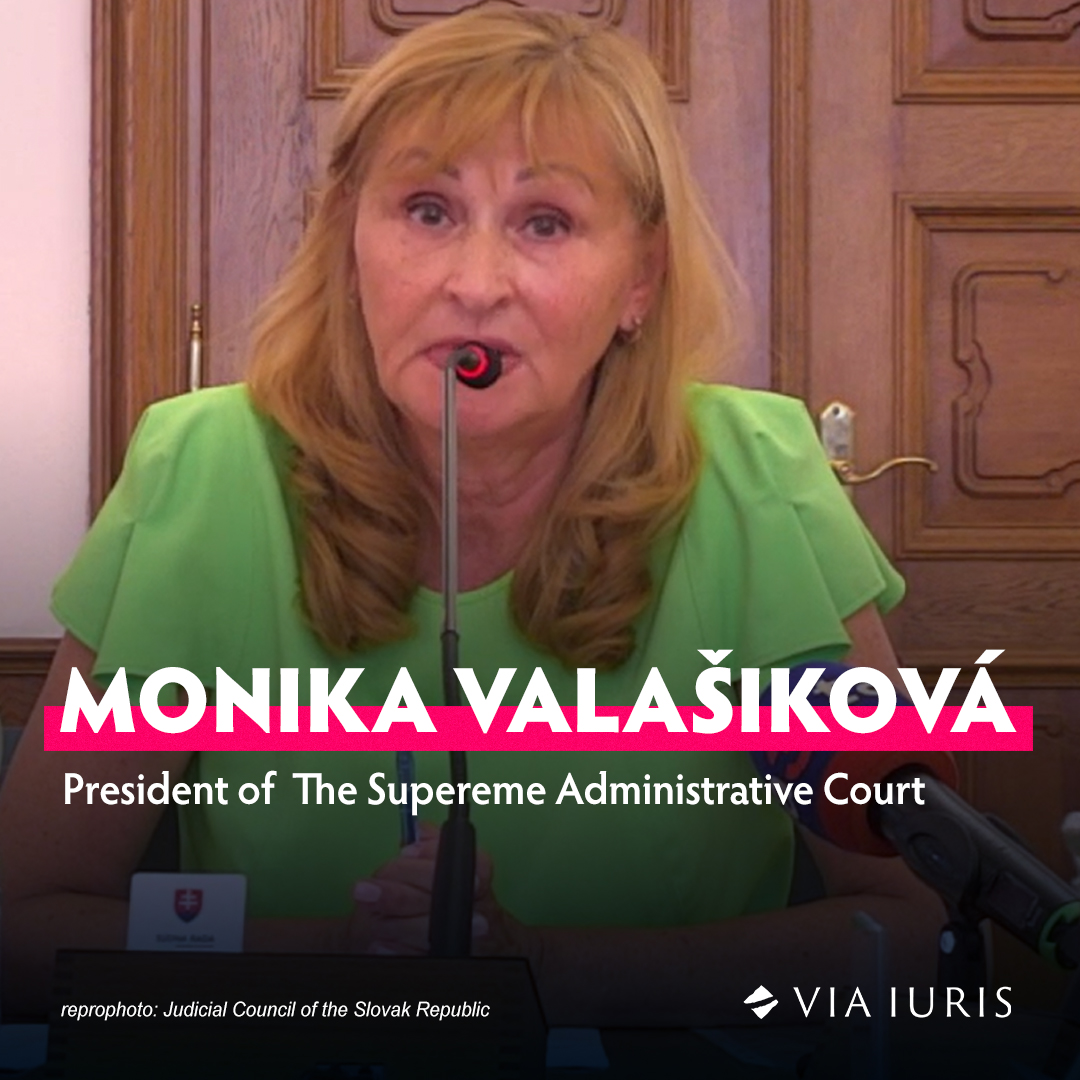
The Judicial Council this week selected a candidate for president of the Supreme Administrative Court (NSS), choosing Monika Valašiková over Marián Trenčan by twelve votes to two. The two hearings laid out contrasting visions of the court: Trenčan spoke positively of an open, modern institution and welcomed the arrival of judges from other legal professions such as advocates, academics, and prosecutors.
He argued that their perspectives, expertise, and language skills had enriched decision-making and reflected an international standard, while offering continuity with the court’s previous leadership. Valašiková, by contrast, was sharply critical of her own court, identifying the absence of administrative and filing rules, shortcomings in case registries, and a departure from earlier case law of the Supreme Court’s administrative divisions as its main problems. She also pointed to the functioning of the grand chambers meant to unify case law, which she said often decide by 4:3 with attached dissents, and proposed composing them with judges able to reach agreement so that votes ideally end 7:0.
VIA IURIS flagged this last suggestion as problematic, reading it to mean that the court’s president could, through influence over the grand chamber’s composition, shape the substance of its rulings. Valašiková further said she would end the court’s podcast and present its work only through a professional legal journal, legal education, and the rulings themselves, describing the judiciary as a conservative body with no need to promote „products or services.“ The contest was a clash of two approaches to building judicial institutions, one open, modern, and cooperative, the other conservative, strictly administrative, and hierarchical.
8. Shameful end of the Russian law on transparency of NGOs
On 4 August 2026, the unconstitutional amendment to the law on non-profit organizations, dubbed the „Russian law“ by its critics, definitively lost effectiveness. The Constitutional Court had found its key provisions unconstitutional, and because parliament did not bring them into line with the constitution within the six-month window, the deadline lapsed and non-governmental organizations remain under the original rules. Ombudsman Róbert Dobrovodský, who brought the challenge together with a group of opposition MPs, said the outcome prevented an impermissible interference with the rights to privacy, the protection of personal data, and freedom of association.
According to the court, such interference cannot be justified by a demand for transparency, since NGOs and their donors are private persons managing their own property. SNS deputies formally submitted the controversial amendment, and 76 MPs from the SMER, HLAS, and SNS coalition passed it before President Pellegrini signed it. Parliament’s failure to even attempt a repair is the clearest evidence of the measure’s underlying intent, which shows itself as an effort to harass civil society rather than to pursue genuine oversight. The governing coalition has signaled it will return to the question of greater NGO transparency, with Prime Minister Fico repeatedly invoking the state’s right to know how such organizations are financed. The definitive expiry thus closes one of the fourth Fico government’s most contested legislative projects.
9. Usual evergreen of the Judicial Council – general and vague against political attacks on judges
The Judicial Council addressed verbal attacks by social media influencer Filip Sulík against a judge of the Bratislava IV City Court, made in a podcast with prime-ministerial adviser Dávid Lindtner, and concluded the debate with what VIA IURIS describes as another general and vague resolution. Under the chair of Marcela Kosová, the Council regularly discusses attacks on judges by politicians and other public figures, but its formal output, the resolution itself, routinely names neither the conduct nor the person responsible, making no exception even for the prime minister or ministers.
The only individuals the Council has explicitly named so far were members of VIA IURIS and an actor of the Slovak National Theatre. This illustrates the pattern: two adopted resolutions condemn „disproportionate verbal attacks“ and restate respect for professional criticism in the abstract, without identifying who attacked whom.
10. New Civil Code in the Parliament
Parliament is set to approve a new Civil Code, but the governing coalition restricted debate on the legislation to the minimum possible time. The code is a substantial recodification of more than 2,000 articles intended to replace the current one dating from 1964, and it reshapes rules on property ownership and inheritance, spousal property relations, contracts and commercial dealings, and even neighbor relations. The Justice Ministry received more than 4,000 comments during the review process and accepted roughly a quarter of them in full or in part, yet opposition MPs were left with only about six hours of floor debate. Curtailing discussion of such far-reaching legislation mocks democracy, as parliamentary debate is a core pillar of representative government, and shortening it should be acceptable only for trivial proposals.
About Zeitgeist
Zeitgeist is the English report of VIA IURIS, in which we try to capture the zeitgeist of the political situation in Slovakia, which has changed dramatically after the parliamentary elections in September 2023.
The 4th government of Prime Minister Robert Fico was formed by a coalition of two, as they call themselves, social democratic parties – SMER-SD, HLAS-SD and the nationalist party SNS. Since the coalition was formed, institutions guaranteeing the rule of law and public control, including Slovak civil society, have been under constant attack.
Previous issues of our report can be found here
Topics: #RuleOfLaw #legislation #media #CivilSociety
VIA IURIS, občianske združenie
Komenského 482/21
974 01 Banská Bystrica
IČO: 00631213
DIČ: 2021066388
Číslo účtu – IBAN
SK39 1100 0000 0026 2548 1827
BIC: TATRSKBX
IBAN v QR code pre internet banking aplikácie: